
Tanzanian Shilling to USD: Your Tanzania Money Guide
You've just landed at Kilimanjaro International Airport, cleared customs, and a driver hands you change from your first purchase. The notes read 50,000 TZS. Then 100,000 TZS. Your brain stalls completely. Are you rich? Did you get scammed? The numbers look like something from a Monopoly game, and for the first few hours in Tanzania, almost every American traveler has this exact moment of mental paralysis.
Once you understand the tanzanian shilling usd relationship, the confusion disappears fast. This guide covers the current exchange rate, where to get the best deal when converting cash, whether you can use dollars directly on safari, and how much cash to actually carry day to day. Worth knowing upfront: operators like Kilimanjaro Local Trips (KLT) price all safari and Kilimanjaro climbing packages in USD with no hidden conversion markups, so your biggest trip costs are already sorted the moment you book. What this guide addresses is the everyday cash layer on top of that.
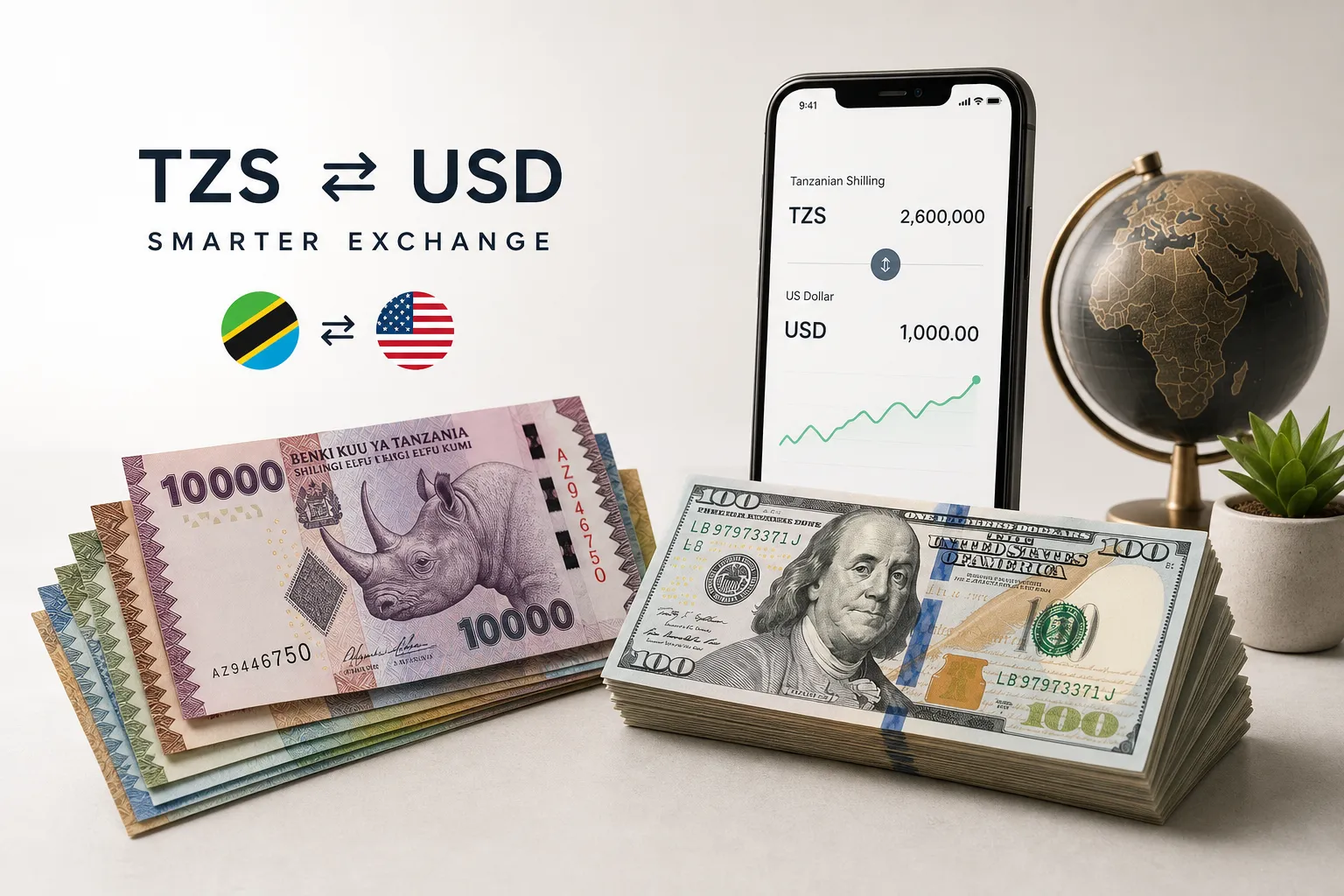 Tanzanian Shilling USD: What the Rate Really Means for Your Wallet
The mid-market exchange rate for the tanzanian shilling usd pair sits around 1 USD to 2,600, 2,640 TZS as of mid-2026. That means every dollar you carry into Tanzania buys you roughly 2,620 shillings. The number sounds enormous, but context makes it manageable: a cold Kilimanjaro beer at a local bar runs about 3,000, 4,000 TZS, which is just over a dollar. Once you anchor shilling amounts to real purchases, the scale clicks into place.
The TZS has been remarkably stable against the dollar over the past year, ranging between about 0.00037 and 0.00041 USD per shilling, with only modest drift. That stability is useful for trip planning because the rate you research three months before your flight is unlikely to look radically different once you land.
The Rate You See on Google vs. the Rate You Get in Person
The mid-market rate is a reference benchmark, not a rate any bank or exchange counter will offer you directly. It represents the midpoint between buy and sell prices in the wholesale currency market. In practice, walk-in exchange counters in Tanzania add a spread of 2, 5% on top of that mid-market figure, and sometimes a flat service fee on larger transactions. Wise, for comparison, uses the mid-market rate and charges a transparent conversion fee starting around 0.57% for the TZS/USD route, making it a useful benchmark for judging how competitive any in-person rate actually is.
How to Do Quick Mental Math on the Ground
A simple shortcut solves almost every calculation you'll need: divide any shilling amount by 2,600 to get the rough USD equivalent. So 26,000 TZS is about $10, and 130,000 TZS is about $50. You can flip it too, multiply your dollar amount by 2,600 to know how many shillings you should be handing over. This mental shortcut saves you every time a market vendor quotes a price that sounds terrifying but works out to $3. To convert Tanzanian shillings to dollars quickly, this divide-by-2,600 rule gets you close enough for any street-level transaction.
Where to Exchange Your Dollars in Tanzania
Not all exchange points are equal, and the gap between the best and worst options can cost you $15, 20 per $500 exchanged. Tanzania has a solid network of licensed forex bureaus and commercial banks in its main cities, and knowing which ones to target makes a real difference to your starting budget.
Forex Bureaus and Local Banks: Your Best Bet for Tanzanian Shilling USD Rates
Licensed forex bureaus in Arusha, Moshi, and Dar es Salaam consistently offer the most competitive rates for converting USD to TZS (TSh to USD works the same way in reverse). Bureau rates typically land within 1, 2% of the mid-market rate, and transactions are fast. In Arusha, well-regarded options include Furaha Safari Bureau de Change on Boma Road near Clock Tower, Sanya Bureau de Change on Sokoine Road, and Kibo Palace Bureau de Change on Joel Maeda Street. For a bank-based exchange, NBC and Standard Chartered both handle foreign currency in Arusha. CRDB and NMB are solid choices in Dar es Salaam.
Bring crisp, post-2009 USD bills. Tanzanian exchangers routinely reject older or worn notes, and smaller denominations under $50 often get a slightly worse rate than $100 bills. This isn't a scam; it's standard practice across the country.
ATMs: Convenient but Check Your Bank's Fees
ATMs are widely available in Arusha, Dar es Salaam, and Moshi, but they become unreliable in smaller towns and essentially disappear inside national parks. Karatu is generally the last practical ATM stop before entering Ngorongoro and Serengeti territory, so plan your cash needs before you leave the gateway cities. Your home bank may charge a foreign transaction fee of 1, 3% plus a flat withdrawal fee on top of the ATM's own rate. Schwab's checking account reimburses all international ATM fees, making it a genuinely useful travel account if you have one.
What to Avoid: Airport Kiosks and Hotel Desks
Airport exchange counters and hotel front desks are convenient but consistently price 5, 8% below mid-market rates. If you need a small amount of shillings on arrival for a taxi or a meal, the airport is fine for that limited purpose. For anything beyond $50, 100, wait until you reach a reputable forex bureau in town. The extra 20 minutes will save you real money.
Can You Use US Dollars Directly on Safari?
This is one of the most common questions American travelers ask before a Tanzania trip. The short answer: yes, more often than you'd expect, especially for the big-ticket items.
Where USD Is Standard, No Conversion Needed
USD is the de facto pricing currency for most of Tanzania's tourism economy. Safari lodges and tented camps quote and accept US dollars directly. National park entry fees are set and collected in USD. Kilimanjaro climbing permits, park levies, and conservation fees are all denominated in dollars. The following major expenses are all settled in USD without any conversion step:
- Hot air balloon safaris over the Serengeti
- Zanzibar resort bills
- Premium lodge upgrades
You can move through an entire safari itinerary handling mostly dollars for the major expenses.
Where Tanzanian Shillings Are Essential
Local markets, roadside food stalls, small restaurants, boda-boda rides, and tips for non-safari staff all run in shillings. Trying to pay 4,000 TZS for a street snack in dollars gets awkward fast, and most vendors won't accept them anyway. Cultural experiences like Arusha's Central Market, independent Maasai village visits, and small craft shops all go smoother with shillings in hand. The shilling layer of your budget is genuinely small compared to your main package costs, but it matters for day-to-day life on the ground.
How Much Cash to Carry on a Typical Tanzania Day
Your daily cash needs depend heavily on what kind of day you're having. Safari days inside a national park involve very little cash spending since your park fees and lodge costs are already handled through your package. Free days in Arusha or Stone Town in Zanzibar require more shillings on hand.
Safari Days: Tips and Incidentals Only
On an active game drive day, budget around $20, 40 in shillings for small purchases and incidentals. The main cash moment comes at the end of your trip when you tip your guide and camp crew. A standard tip structure runs roughly $20, 25 per person per day for a lead guide, $10, 15 for a cook, and proportional amounts for other crew members. Set aside a dedicated tip envelope before your trip so you're not scrambling to assemble the right amounts on departure morning.
City and Beach Days: Plan for More Flexibility
A day in Arusha browsing the local market or eating at non-tourist restaurants could run $30, 60 in shillings depending on your shopping habits. In Zanzibar's Stone Town, factor in $15, 25 for meals at local restaurants, plus whatever you plan to spend on spices, fabrics, or carved goods. Carrying the equivalent of $50, 80 in shillings on a free day gives you comfortable room without over-exposing yourself to carrying large amounts of cash. For a full week of combined safari and city time, most travelers need roughly $350, 700 in shillings total for incidentals and tips, exclusive of major optional activities.
How USD Pricing Simplifies Your Overall Tanzania Budget
The single biggest relief for American travelers in Tanzania is that the major costs are almost always quoted in dollars. You're not converting thousands of dollars into a foreign number and hoping the math works out correctly at checkout.
Kilimanjaro Local Trips builds all package pricing in USD with no hidden conversion layer. What you see on your quote is what you pay: no local currency surcharge, no rate adjustment at checkout because the shilling moved while you were in transit. That transparency means you can plan your full Tanzania budget in dollars from the start, cleanly separating the large fixed costs of your package from the smaller daily variable spending on markets, meals, and tips.
Once your safari or climb package is sorted, the shilling side of your budget is manageable. A reasonable estimate for most travelers is $30, 60 in shillings per day for incidentals, tips excluded. Keep your tip envelope separate from your daily spending cash so the two pools don't blur together as the trip progresses. Understanding the tanzanian shilling usd conversion rate, and knowing that your major costs are already locked in dollars, makes budgeting straightforward from day one.
Practical Moves to Make Before Your Flight Lands
A few decisions made before you leave the US will save you real money and frustration once you're on the ground in Tanzania.
Cash Denomination Strategy and Security
Bring a mix of $100, $50, and $20 bills, all crisp and in good condition. The $100 bills get the best exchange rates at bureaus; $20s are useful for smaller transactions and direct USD tips. Store your cash in two separate locations: one in your day bag and one secured deeper in your luggage. A money belt under your clothing is worth using in busy city markets; it's less necessary inside a national park or lodge compound.
Cards, Backup Plans, and Leftover Shillings
Carry at least one Visa or Mastercard as a backup. Most upscale lodges accept cards, though remote camps may not have reliable connectivity for processing. Notify your bank before you travel to prevent fraud blocks on international charges. For leftover shillings at the end of your trip, you can reconvert them at a Dar es Salaam or Kilimanjaro Airport bureau before you fly out, though the reconversion rate is slightly worse than your initial exchange. The cleaner strategy is simply not to over-exchange in the first place: withdraw or exchange in smaller increments and top up as needed rather than converting a large lump sum at the start of your trip.
Ready to stop worrying about money logistics and start planning the actual adventure? Kilimanjaro Local Trips handles the USD-denominated side of your Tanzania trip with full transparency: no hidden fees, no currency surprises, and 24/7 support from people who live and work here every day. Get in touch and we'll build your itinerary from the ground up, so you can focus on the experience, not the exchange rate.