
Serengeti vs Masai Mara: Best Place to See the Great Migration
Both parks sit inside the same ecosystem. The same wildebeest herd moves through both. So why do so many travelers book a safari and come home having missed every river crossing? Many travelers choose a destination rather than matching their travel dates to migration timing, and that mismatch is what costs them the experience. The Serengeti and the Maasai Mara aren't competing products. They're two stops on the same annual circuit, and this Serengeti vs. Maasai Mara great migration comparison will show you that the park that wins for your trip depends entirely on when you can travel.
What follows draws on firsthand positioning knowledge from inside Tanzania, the kind of on-the-ground insight the team at Kilimanjaro Local Trips applies when placing guests at the right crossing point on the right day. It covers the full annual cycle, the specific months each park dominates, where crossings actually happen, what things cost in 2026, and a clear framework for making your decision.
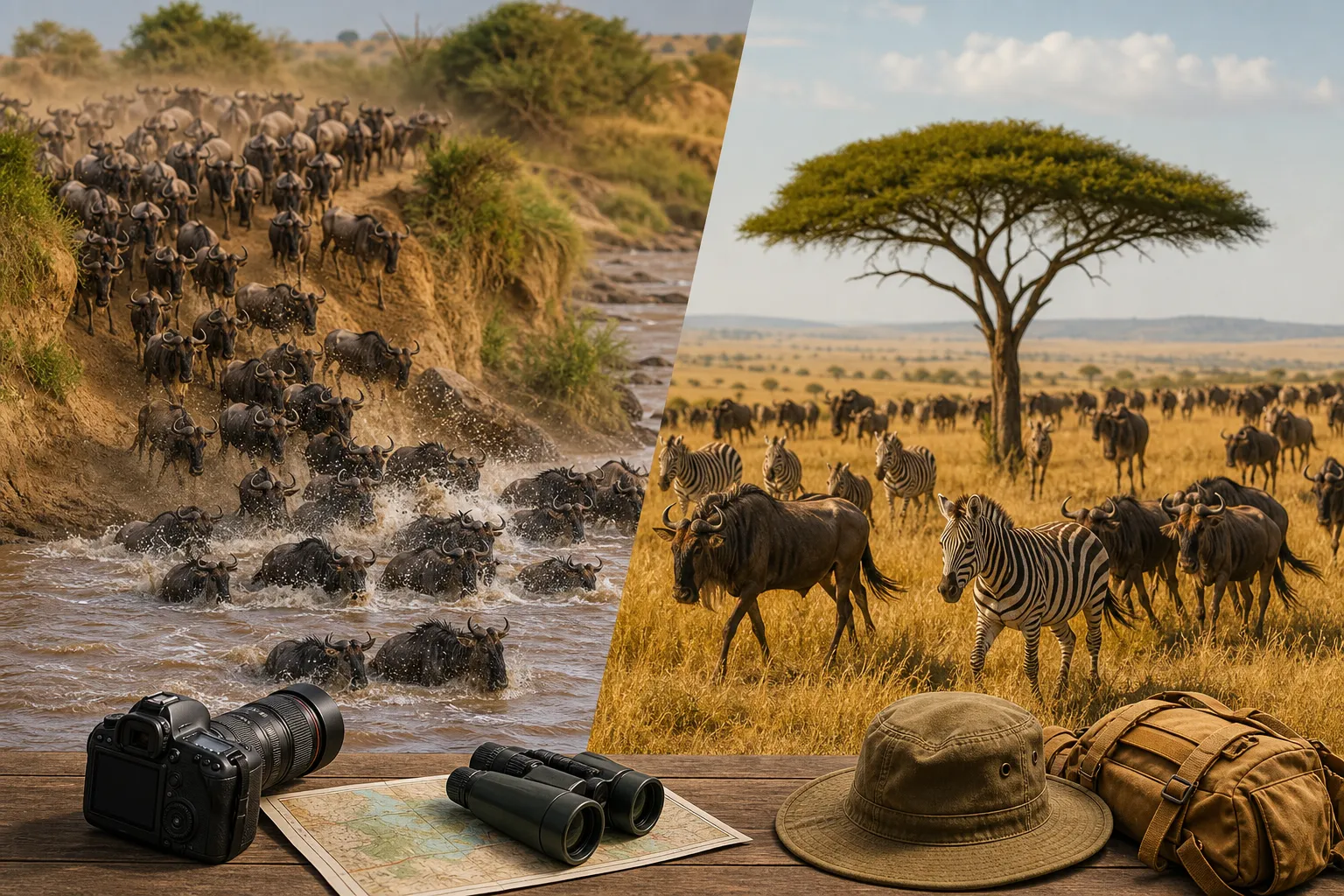
How the wildebeest migration actually moves across the ecosystem
Most people picture the Great Migration as a single dramatic river crossing. In reality, it's a year-round circular movement driven by rainfall, and the full circuit spans roughly 30,000 square kilometers between Tanzania and Kenya. The herds follow fresh grass, not a calendar, which means understanding the loop is the only way to make sense of any timing decision.
The annual circuit in plain terms
The herds spend January through March on the southern Serengeti plains, where calving peaks in February with hundreds of thousands of births in a matter of weeks. The Ndutu area is the epicenter during this period, and predator activity hits a fever pitch as lions, cheetahs, and hyenas track newborns across open grass. By April and May, the column pushes north and west through the central Serengeti toward the Grumeti River.
From July onward, the herds reach the northern Serengeti and begin stacking at the Mara River before spilling into Kenya. By October and November, they turn south and the cycle resets. The location that wins for any given trip is determined entirely by the month you travel.
Why rainfall drives everything
The wildebeest track new green growth triggered by rain, not a fixed schedule. A late rainy season can push the northern Serengeti arrival into August; an early dry spell can pull it forward to late June. This variability is why real-time local guidance matters far more than any fixed travel calendar, and why working with a locally based Tanzania operator gives you a meaningful edge over booking with an agency that has no boots on the ground in Tanzania.
Month-by-month timing: Serengeti vs. Maasai Mara great migration comparison
The two parks don't compete year-round. They take turns hosting the main herd, and the handoff happens in July. Get this window wrong and you'll spend your game drives looking at scenery instead of crossings.
When the Serengeti holds the advantage
The southern and central Serengeti dominate from January through June. February is the undisputed highlight for calving, with the Ndutu area delivering some of the most dramatic predator-prey action on the continent. June brings Grumeti River crossings in the western corridor, a spectacle most travelers never consider. The northern Serengeti then becomes the front line for Mara River crossings starting in mid-July, with peak crossing activity running through August. During that window, crossing points like Kogatende typically see 3 to 10 vehicles, compared to the 40 to 100-plus that routinely pile up at the equivalent Kenyan sites.
When the Maasai Mara takes over
The Mara's window runs from August through October. September typically delivers the strongest herd concentrations inside the reserve's compact footprint. The prey density pulls predators into a tighter area, and sighting rates for lions and cheetahs spike accordingly. By late October, the herds start filtering back south into Tanzania, and the Mara quiets down until the following year.
Where the river crossings actually happen
The Mara River crossing is the iconic image of the migration, but its exact location matters more than most travelers realize. Arriving at the wrong bend can leave you well out of viewing range with no practical way to reposition quickly.
Key crossing points in Tanzania's northern Serengeti
The Kogatende area is the most reliable and frequently visited crossing zone on the Tanzanian side, with multiple active crossing points within a short drive. The Lamai Wedge sits just north of Kogatende and is a favorite for photographers due to elevated sightlines over the river. The Bologonja area offers consistent crossings from mid-August through September with notably fewer vehicles than Kogatende. These locations are accessible from camps in the northern Serengeti and deliver crossing action from mid-July through September before the herds push fully into Kenya.
Key crossing points in Kenya's Maasai Mara
The Mara Triangle and Lookout Hill area on the Kenyan side feature a wide river bend that concentrates wildebeest and crocodiles into a natural amphitheater. Paradise Plains and the Governor's Camp zone are the other major crossing sites. Sand River, near the Tanzania border, is often where the first advance groups enter Kenya in July. The tradeoff: Mara crossings at the main reserve sites routinely draw 40 to 100 vehicles during peak August and September, and the vehicle congestion at peak sites frequently overwhelms the wildlife experience itself. The Mara Triangle and private conservancies enforce stricter vehicle discipline, limiting cars per sighting and delivering a noticeably more orderly experience.
The Grumeti River: a crossing most people skip
The western corridor's Grumeti River crossings happen in June and are largely off the radar for first-time migration travelers. The crocodiles here rank among the largest in the ecosystem, competition for vehicles is minimal, and the intensity rivals anything the Mara River delivers. For travelers with flexible timing, June in the western Serengeti offers a crossing experience with a fraction of the crowd pressure found anywhere in Kenya during peak season.
Wildlife quality and park atmosphere compared
Beyond the crossings, the two parks deliver noticeably different safari environments. Size is the biggest factor in that difference.
What the Serengeti's scale means for your game drive
At roughly 14,763 square kilometers, the Serengeti is nearly ten times the size of the Maasai Mara. That scale means fewer vehicles around any single sighting. The terrain varies widely, short-grass plains, acacia woodlands, kopje rock formations, and riverine forest, and a single day can accommodate multiple distinct activities. The lion population of approximately 3,000 individuals is the largest of any protected area in Africa, though finding them requires covering ground. The landscape alone justifies a visit even outside peak migration windows.
What the Mara's compact size delivers
The Mara covers roughly 1,510 square kilometers and concentrates prey and predators into a tighter space during migration season. Per-hour sighting rates for lions and cheetahs spike from July through October as predators stake out river crossings. Cheetah coalitions shift almost entirely to wildebeest during this period, and lion prides specialize in ambush near the crossing points. The density is extraordinary during those two to three months, but so is the vehicle traffic at the most famous crossing sites in the main reserve.
Costs and logistics: what each option requires in 2026
Budget is often what tips the decision for American travelers. The numbers tell a consistent story at every accommodation tier.
Breaking down the cost difference
Serengeti National Park charges $83 per adult per day during peak season (mid-May through mid-March), while Maasai Mara conservation fees run approximately $80 per day, verify the current figure with Kenya Wildlife Service before booking, as 2026 rates are subject to change. Accommodation follows the same general pattern: mid-range lodge options in the Serengeti typically run $150 to $300 per person per night during peak season, compared to $250 to $450 on the Kenyan side. A 7-day all-inclusive Serengeti safari ranges from roughly $2,500 to $7,500 depending on accommodation tier; the Mara equivalent runs $3,000 to $8,000. For budget-conscious travelers, Tanzania is consistently the more affordable option, and the gap widens at the luxury end.
Getting there and moving around
Most international travelers arrive into Kilimanjaro International Airport (JRO) near Arusha, then transfer by road or short connecting flight to Arusha Airport (ARK) before boarding domestic carriers like Coastal Aviation or Regional Air to Kogatende airstrip. The current one-way fare from Arusha to Kogatende runs approximately $402 per person, with flights taking roughly 1 hour 40 minutes. The Maasai Mara is accessed through Nairobi's Jomo Kenyatta International Airport, with domestic flights to the Mara running $250 to $300 one-way from Nairobi. Overland from Arusha to the northern Serengeti takes 6 to 8 hours, making the fly-in option worth the cost for any itinerary of 5 days or shorter. Flying directly to Kogatende also maximizes the time you spend at crossing points rather than in transit.
Which park is the right choice for your trip
There's no universal winner. The right answer depends on your travel window, your budget, and what kind of game drive environment you want to be in.
Choose the Serengeti if...
You're traveling any month outside August and September, you want the calving season in February, you want Grumeti crossings in June, or you prefer a less crowded game drive environment throughout. The Serengeti also wins on overall value and on the variety of landscapes you can cover in a single itinerary. For travelers who want expert positioning, knowing whether to base in the western corridor versus the northern sector based on real-time herd movement, a locally based Tanzania operator is the clearest advantage available. The team at Kilimanjaro Local Trips monitors herd positions throughout the season and places guests at the correct crossing points before the crowds arrive, an advantage that comes from operating on the ground in Tanzania year-round.
Choose the Maasai Mara if...
Your travel window is fixed in August or September, you're combining the safari with other Kenya destinations, or maximum predator density during peak crossing season is your top priority. The Mara delivers genuine intensity during those two months, particularly inside the Mara Triangle and private conservancies where vehicle numbers are controlled. Go in with realistic expectations about the experience at the main reserve crossing points during peak weeks.
The honest recommendation
For most American travelers with a flexible schedule, the Serengeti offers more value across the full year. The combination of year-round migration access, lower costs, greater landscape variety, and the ability to add a Zanzibar beach extension through a single Tanzania itinerary makes it the stronger overall choice. Book the Mara if your dates are non-negotiable in late August through September and crossing frequency is the only variable that matters.
The bottom line
The Mara earns its reputation in August and September. The Serengeti earns everything else. This Serengeti vs. Maasai Mara great migration comparison ultimately shows that understanding the annual wildebeest circuit, knowing which river crossings are active in which months, and positioning yourself at the right camp for real-time herd movement are what separate a memorable safari from a missed experience. Those details are not things you can reliably sort out from a travel booking platform.
If you're planning a Tanzania-based migration safari and want expert guidance on timing and camp positioning, reach out to Kilimanjaro Local Trips directly. The advantage of booking with a locally based operator is knowing exactly where the herds are moving before you land, and being placed there on the right day.