
Africa Safari Comparison: Which Country Is Best for You in 2026?
Making an Africa safari comparison is the first step every American traveler needs to take before booking, and it's often the most paralyzing one. Five countries, wildly different price tags, and everyone online seems to have a different opinion. Kenya versus Tanzania is the classic debate, but then someone mentions Botswana's Okavango Delta, Rwanda's gorillas, or South Africa's self-drive Kruger, and suddenly the decision tree branches into something unmanageable.
Each of these countries has a distinct personality. Tanzania is vast, diverse, and built for the complete safari experience. Kenya is compact and efficient. Botswana is ultra-exclusive. South Africa is the most accessible for first-time international travelers. Rwanda is uniquely focused. We at Kilimanjaro Local Trips have extensive experience running safaris out of Tanzania and field this question from American travelers more than any other, so here's the honest breakdown. (Full disclosure: we operate safaris in Tanzania, so we encourage independent research alongside this guide.)
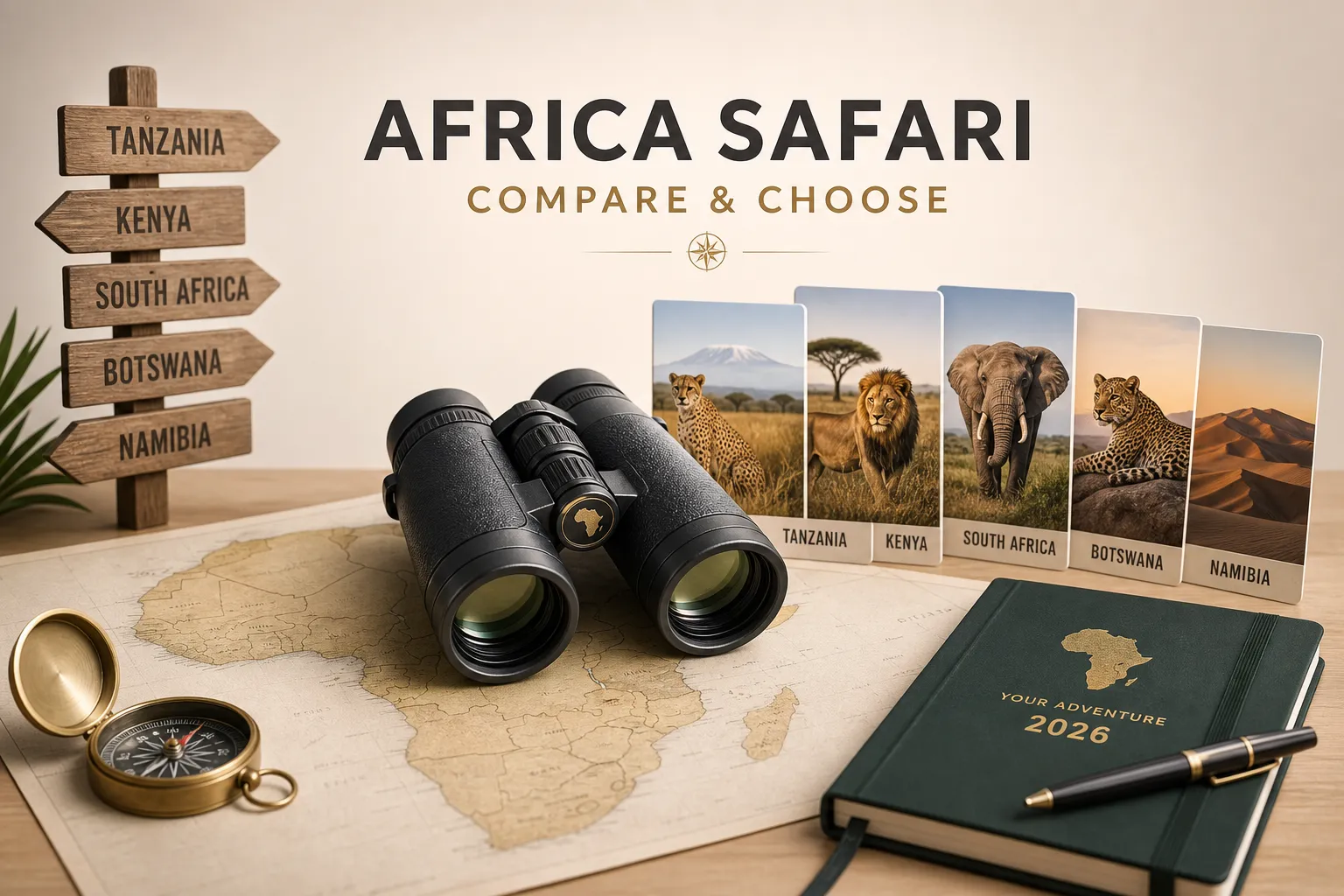 Africa Safari Comparison: What Each Country Actually Delivers
The Tanzania and Kenya migration corridor
Tanzania's Serengeti and Kenya's Maasai Mara are part of the same wildebeest ecosystem, divided only by a border. The scale difference is significant: the Serengeti spans roughly 14,750 square kilometers compared to the Mara's approximately 1,510 square kilometers. Tanzania offers dramatically more wildlife variety across a much larger landscape, though sightings can require longer drives between locations. The crowd numbers tell a similar story: during peak August migration, the Kenyan side of the Mara River regularly sees more than 100 vehicles at a single crossing, while the Serengeti side typically sees 40, 70 vehicles.
Tanzania's northern circuit adds another critical advantage: you can combine the Serengeti with Ngorongoro Crater and Tarangire National Park in a single 7, 10 day trip, covering three completely distinct ecosystems without ever changing countries. Kenya's Mara is the better choice if you have under 7 days and want maximum efficiency, particularly for the famous river crossings in August and September.
Botswana and Rwanda: niche experiences with premium price tags
Botswana's Okavango Delta and Chobe National Park are genuinely extraordinary destinations. Water-based safaris, massive elephant populations along the Chobe River, and ultra-exclusive small camps create an experience unlike anything in East Africa. The catch: Botswana is the most expensive destination in this comparison by a significant margin, with mid-range options starting at $700, $1,200 per person per day. Budget options are extremely limited and uncommon here.
Rwanda's offering is distinct and focused: gorilla trekking in Volcanoes National Park. This is not a traditional safari. Trek duration varies widely, commonly 2, 8 hours, and encounters are limited to one hour once the gorillas are located. Permits alone cost $1,500 per person, and the experience is best treated as a 3, 4 day add-on to a broader East Africa trip rather than a standalone safari. Both countries reward travelers who know exactly what they want before they book.
South Africa's accessible, self-drive character
Kruger National Park is the only major destination on this list where self-drive is genuinely practical and popular. Paved roads, clearly marked camps, and malaria-free options in some adjoining private reserves make it approachable for travelers who want independence. The Big Five are present with strong rhino numbers that are harder to find in East Africa. Near-direct flights from New York to Johannesburg reduce travel friction compared to East Africa routing. That's a real logistical edge for some travelers, but it comes at the cost of ecosystem scale and migration access.
Africa Safari Comparison: Costs, Wildlife & Best Times
Africa Safari Comparison, Daily Price Ranges by Country
Tanzania offers the broadest price range of any destination here. Budget group camping safaris run $150, $250 per person per day; solid mid-range lodge experiences land at $350, $550 per day; luxury private concession camps hit $1,500, $3,000 per night. A quality 7-day northern circuit safari totals around $3,500, $5,500 per person, excluding international flights. Kenya sits in a comparable range for mid-range and luxury brackets, though private Mara conservancy fees add cost for exclusive vehicle access.
Botswana's entry point is a different conversation entirely. Mid-range options start at $700, $1,200 per person per day, with luxury running $1,500, $3,000 and beyond. South Africa is the most flexible: self-drive Kruger camping typically starts around $150 per day on the low end when factoring in a rental car and a basic campsite, while luxury private reserves hit $1,000, $2,500 per day. Rwanda's gorilla permit alone is $1,500 per person; a typical 3-night trip runs $3,000, $5,000 total per person before international flights.
Where Tanzania's value proposition stands out
Tanzania is the only destination where you can book a budget camping safari, a mid-range tented lodge trip, or a luxury fly-in experience, all within the same park ecosystem. Total trip budgets for 7, 10 nights break down roughly as follows: $4,500, $6,000 for entry-level, $6,500, $10,000 for high-quality mid-range, and $12,000, $18,000 for luxury. Booking directly through a locally owned Tanzania operator cuts the Western agency markup that typically inflates those totals by 20, 35 percent.
Best times to go: wildlife peaks by country and target animal
The Great Migration calendar: Tanzania versus Kenya
Tanzania owns the majority of the migration year. Calving season runs January, March (peaking in February) in the southern Serengeti near Ndutu, where 500,000 or more calves are born over a few weeks with lions, cheetahs, and leopards hunting actively throughout. The herds move north through Tanzania from April to June before crossing into Kenya's Mara from mid-July through October. The famous Mara River crossings peak in August and September.
If you can only visit once and want to witness multiple migration phases, Tanzania's calendar coverage is unmatched. Kenya's compact Mara wins on intensity and accessibility during those specific August, September crossing weeks. Choose based on when you can travel, not just where.
Dry season advantages in Southern Africa and beyond
South Africa, Botswana, and Namibia all peak in the dry season from June through October. Vegetation thins and animals concentrate at water sources, delivering better visibility across the board. Botswana's elephant herds are most spectacular in July, October along the Chobe River, and South Africa's Kruger is reliably strong from May through September. Rwanda's gorilla trekking runs year-round, but June, September and December, January offer drier trails and more manageable conditions for the hike itself.
Getting to Africa from the US: what the routing actually looks like
East Africa versus Southern Africa routing from US cities
East Africa requires some travel tolerance. From New York, Los Angeles, or Chicago, expect 16, 20 hours of total travel with at least one connection, typically routed through Amsterdam, Doha, Dubai, London, or Addis Ababa into Kilimanjaro International Airport (JRO) or Nairobi's JKIA. Round-trip fares from New York to JRO currently range from $1,028, $1,565 depending on the month, with September often offering lower fares.
Southern Africa is slightly more convenient. Near-direct options from New York to Johannesburg bring total travel time to 15, 18 hours, and Botswana routes through Johannesburg as its primary hub. Rwanda sits in between, typically routed through Brussels, London, or Addis Ababa, with total travel of 18, 22 hours from the US East Coast.
Visa logistics for US passport holders
Entry requirements are straightforward across all five countries. Tanzania requires a visa for US citizens; the e-Visa is applied online through the official Tanzania immigration portal at a cost of $100 for a one-year multiple-entry visa, with processing typically taking 5, 10 business days. Visa on arrival is also available. Kenya uses an electronic travel authorization, also applied online. South Africa and Botswana require no visa for US citizens for stays up to 90 days. Rwanda offers visa on arrival and an e-Visa option. Pre-trip friction is low across the board.
Matching your safari style and travel personality to the right country
Game drives, mobile camps, and the Tanzania case for first-timers
Guided game drives are the most accessible safari style available: no fitness requirement, guides handle all the wildlife knowledge, and vehicle-based viewing gets you within meters of animals safely. Tanzania's Serengeti and Ngorongoro Crater are ideal game drive destinations, offering consistent Big Five sightings across dramatically different landscapes in a single itinerary. For first-time American safari-goers, Tanzania's northern circuit, covering Tarangire, Serengeti, and Ngorongoro in 7, 10 days, delivers more wildlife variety per dollar than any other single-country itinerary in this safari package comparison.
Mobile camping, where camps relocate seasonally to follow the migration, offers the most immersive experience for serious wildlife watchers. Budget mobile safaris run $150, $400 per day; premium versions with full staff and en-suite facilities reach $400, $700 per day. Adding a Zanzibar beach extension after the safari gives American travelers a genuinely complete African experience: savanna, crater, and Indian Ocean, all in one trip. Kilimanjaro Local Tripsspecializes in building exactly this kind of end-to-end Tanzania itinerary for American travelers, customized to budget, trip length, and wildlife priorities, with transparent, itemized pricing.
Game-drive vs. walking safari: matching format to destination
Beyond the vehicle-based game drive, walking safaris are available in Tanzania's Selous (Nyerere National Park), Zambia's South Luangwa, and parts of Botswana. They suit experienced safari travelers who want slower, more immersive wildlife encounters. South Africa's private reserves also offer guided bush walks. If choosing between safari styles, luxury vs. budget, Tanzania again stands out for offering both within the same park system, giving travelers genuine flexibility regardless of what they're spending.
When to choose a different country instead
The right country depends entirely on what you're optimizing for. When you compare safari destinations side by side, the decision usually comes down to four clear scenarios:
- Choose Kenya if you have under 7 days and want maximum efficiency in a compact reserve during the July, October river crossing season.
- Choose South Africa if you want self-drive flexibility, malaria-free reserve options, or a safari combined with Cape Town or the Winelands.
- Choose Botswana if budget is secondary and ultra-exclusive, low-crowd water-based safaris are your priority.
- Choose Rwanda if gorilla trekking is your primary goal and you're building a short, focused trip around one extraordinary encounter.
How to choose an operator you can actually trust for this trip
What separates a trustworthy operator from a middleman
Licensing and certification matter more than marketing language. Look for operators registered with the Tanzania Tourist Board (TTB) or the equivalent national tourism authority for your destination, Tanzania's Ministry of Natural Resources and Tourism maintains official registration requirements you can verify. For Kilimanjaro climbs specifically, guides should carry credentials issued by the relevant park authority (KINAPA), and experienced safari guides bring years of park-specific knowledge that a Western booking agent simply cannot replicate. Experienced guides often improve your chances of sightings, particularly for big cats and nocturnal species.
Transparent, itemized pricing is the clearest trust signal you can look for. Legitimate local operators show you exactly what park fees, vehicle costs, accommodation, and guide fees add up to, rather than quoting a single package price that obscures markup. Response time, trip customization depth, and 24/7 in-country support matter most for American travelers booking their first major international trip. You need someone who picks up when your flight lands at Kilimanjaro International Airport at 6 a.m.
Why booking directly with a local Tanzania operator changes the equation
Western travel agencies typically add 20, 35 percent on top of what a local operator charges for the same vehicle, same guide, and same camps. That markup funds their overhead, not your experience. Kilimanjaro Local Trips is a locally owned Tanzania operator that builds fully customizable safaris for American travelers, covering northern circuit game drives, Zanzibar beach extensions, and Kilimanjaro climbing expeditions, all quoted in USD with transparent, itemized pricing.
For first-time safari-goers working through this comparison, Tanzania's combination of wildlife diversity, accessible pricing at multiple budget levels, and the flexibility of a trusted in-country partner makes it the clearest starting point. You get more ecosystem variety per trip, more migration coverage across the calendar year, and a local operator who is accountable on the ground, not a continent away.
The bottom line on this Africa safari comparison
Each country earns its place on the list:
- Kenya delivers compact, high-efficiency action in a short window, ideal if you're time-constrained and targeting the river crossings.
- Botswana offers unmatched exclusivity at a premium price, with water-based experiences you won't find elsewhere.
- South Africa gives you self-drive freedom, malaria-free reserve options, and easy international routing.
- Rwanda is the only destination for mountain gorilla trekking, best as a focused add-on rather than a primary safari.
- Tanzania covers more ground, more wildlife, and more trip styles than any of the others combined.
For most American travelers with 8, 12 days, a mid-range budget, and a desire to see the Great Migration alongside diverse ecosystems, Tanzania is the strongest choice in this Africa safari comparison. The northern circuit alone justifies the long-haul flight, and a Zanzibar extension makes the trip genuinely hard to top.
Ready to stop comparing and start planning? Send us your travel dates and we'll build a custom Tanzania itinerary around your budget and wildlife priorities. Kilimanjaro Local Trips handles everything from the moment your flight touches down at Kilimanjaro International Airport.